

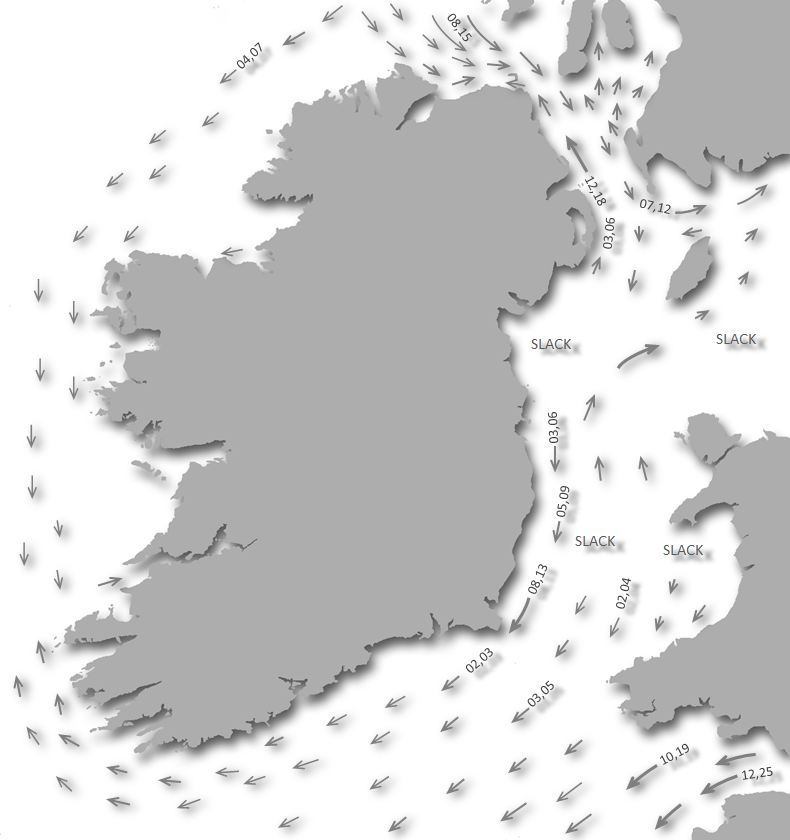
Kilclief provides a good anchorage that is protected from almost all winds except the general Narrows exposure, northeast – southeast, with very secure holding out of the main tidal stream. Within The Narrows it would require a force six or more from the exposed quadrants to make a location become uncomfortable as there is little or no fetch. Tidal timings are vital for approach with currents that attain seen and a half knots in various parts of the Narrows. As a minimum, all vessels should plan to enter with the flood and leave with the ebb, preferably at slack water.

Keyfacts for Kilclief Bay
Facilities
None listedNature


Considerations


Protected sectors

Approaches

Shelter

Last modified
November 7th 2022 Summary* Restrictions apply
A good location with careful navigation required for access.Facilities
None listedNature
Considerations
Position and approaches

Expand to new tab or fullscreen
Haven position
 54° 20.130' N, 005° 32.330' W
500 metres west of the Kilclief Castle in 3 metres.
What is the initial fix?
The following Strangford Lough Initial Fix will set up a final approach:
 54° 18.266' N, 005° 29.492' W



What are the key points of the approach?
Offshore details for vessels approaching Strangford Lough from the north are available in the northeast Ireland’s coastal overview for Malin Head to Strangford Lough  . Details for vessels approaching from the south are available in eastern Ireland’s coastal overview for Strangford Lough to Dublin Bay . Details of the approaches, tidal timings, the run up The Narrows and onward to Killyleagh, on the Lough's western shore, are covered in the Entering and exiting Strangford Lough route description.
. Details for vessels approaching from the south are available in eastern Ireland’s coastal overview for Strangford Lough to Dublin Bay . Details of the approaches, tidal timings, the run up The Narrows and onward to Killyleagh, on the Lough's western shore, are covered in the Entering and exiting Strangford Lough route description.Not what you need?
Click the 'Next' and 'Previous' buttons to progress through neighbouring havens in a coastal 'clockwise' or 'anti-clockwise' sequence. Below are the ten nearest havens to Kilclief Bay for your convenience.
Ten nearest havens by straight line charted distance and bearing:
- Cross Roads - 0.8 nautical miles NNW
- Strangford Harbour (Strangford Village) - 2.3 nautical miles NNW
- Portaferry - 2.6 nautical miles N
- Audley's Roads - 2.8 nautical miles NNW
- Audley’s Point - 3.2 nautical miles NNW
- Ballyhenry Bay - 3.3 nautical miles NNW
- Chapel Island - 3.5 nautical miles NW
- Between Jackdaw & Chapel Island - 3.7 nautical miles NW
- Jackdaw Island - 3.8 nautical miles NW
- Salt Island (South) - 4.4 nautical miles WNW
These havens are ordered by straight line charted distance and bearing, and can be reordered by compass direction or coastal sequence:
- Cross Roads - 0.8 miles NNW
- Strangford Harbour (Strangford Village) - 2.3 miles NNW
- Portaferry - 2.6 miles N
- Audley's Roads - 2.8 miles NNW
- Audley’s Point - 3.2 miles NNW
- Ballyhenry Bay - 3.3 miles NNW
- Chapel Island - 3.5 miles NW
- Between Jackdaw & Chapel Island - 3.7 miles NW
- Jackdaw Island - 3.8 miles NW
- Salt Island (South) - 4.4 miles WNW

Chart

What's the story here?
 Kilclief Castle on the western shore of The Strangford Narrows
Image: Michael Harpur
Kilclief Castle on the western shore of The Strangford Narrows at the entrance to Strangford Lough. It is located about 1½ northward of Killard Point, northwestward of Angus Rock and is 4 km south of the village of Strangford. Kilclief is positioned close to a sandy beach set into a sheltered embayment that has made a key landing point for centuries on end. This is well evidenced by its tall, square, four-storey high tower-house, which still stands watch over it today.
 The bay offers hard sand beach landings
Image: Michael Harpur
The bay offers an anchorage out of the run of the tide in a rural setting with a white sand beach to land upon.
How to get in?
 Kilclief Castle overlooking Angus Rock and the entrance to Strangford Lough
 Image: Michael Harpur
c] Details of the approaches, tidal timings, the run up The Narrows and onward to Killyleagh, on the Lough's western shore, are covered in the Entering and exiting Strangford Lough
route description. Continue on this track past Angus Rock or reef, on the west side of East Channel to Strangford Lough. Kilclief Castle, with Kilclief Church close southwest, will be seen on the western shore. The castle is a tall, four-storey high square tower-house, and will be unmistakable. 
 The Angus Rock tower with Kilclief in the backdrop
Angus Rock is situated nearly in the middle of the entrance, about 1 mile north of Killard Point. It is about a ½ mile long including the Garter and Potts rocks off its southern end and is 200 metres wide. The greater part of Angus Rock uncovers at low water and a light is shown from a prominent tower, Fl.R515m5M, white with a red top, standing on the northern end of the rock that never covers. There is also a truncated obelisk beacon situated 300 metres south of the tower standing on Tail of Angus.
 The Angus Rock tower with the obelisk beacon standing on Tail of Angus.
When Angus Rock is clear steer for the castle. Vessels carrying any draft should note the Meadows Shoal, an area with a least depth of 2.3 metres over it, that lies 300 metres northward of the extremity of Angus Rock.
 The Angus Rock tower as seen from the strand at Kilclief
Image: Michael Harpur
Track into the inner bay paying careful attention to steerage when passing from the main tidal streams of the fairway into the comparative slack water of the inner bay. On close approaches, expect to see a handful of boats on moorings in the south end of the bay.
 The approaches from Angus Rock
Image: Michael Harpur
Anchor according to draught in excellent muddy gravel holding that is out of the main run of the Narrows' tidal streams. Land by tender on the nice small hard sand beach.Why visit here?
Kilclief, (locally kill-leaf) took its name from a basic church dating back to the first days of Irish Christianity. The word 'Kill' is directly taken from the Latin 'Cella', meaning 'a room in a building' so its use marks the arrival of Christianity in Ireland in the 5th century. It is the conjunction of 'Cill-Chlé'Seithe' or 'cleithe' [clčha] meaning 'church of wattle' or 'hurdle church' which indicated it had a very basic early church here. The Church of Ireland near the castle occupies the site where it would have stood. Kilclief sandy beach and sheltered embayment has made it a historical landing
point
Image: Michael Harpur
By the 10th century, there was a stone church which attracted unwanted attention. Kilclief's first mention comes from the Annals in the Four Masters where it noted that in 1001 "Sitric son of Amlaff set out on a predatory excursion into Ulidia in his ships; and plundered Kilclief and Inis -Cumhscraigh". The first Anglo-Norman fortification here was a Motte that was ascribed to Courcy. It would have been part of his initial chain of Mottes, such as at Donaghadee and Ballyhalbert, which are located at the few established landing places along this coast and are mostly inter-visible to allow for inter-site communication. These overlooked the primary shipping lanes and routeways in the northern part of the Irish Sea and are sited to be able to observe the movement of marine traffic and control landfall. Their position at landfalls also meant that they controlled access to the hinterland and played an important governing role in accessing terrestrial communication routes.
 Kilclief vista over the entrance to Strangford Lough
Image: Michael Harpur
The subsequent dominating Kilclief Castle, or more correctly tower-house, was built between 1413 and 1441 making it the oldest surviving tower house in Ulster and one of the oldest in Ireland. It was built to be the summer manorial residence of the newly appointed bishop of Down, John Sely. The tower has an unusual gatehouse style, echoed in Ardglass and nearby Audley's Castle. The doorway and the reconstructed windows in the east wall also display a distinctly ecclesiastical style. The castle has had a peaceful history but it was not without some drama.
 Kilclief Castle
Image: Michael Harpur
It was the centre of a major scandal from the outset when the bishop was found to be living in the 'castro de Kylcleth' with Lettice Whailey Savage, a married woman. Although the Primate served him with a monition in 1434, threatening suspension and ex-communication, the Bishop obstinately persisted. The Pope finally stripped Bishop Sely of the seat of Down and 1441 and in 1443 he was ejected and deprived of his offices.
 Kilclief Castle's walls have stood the test of time
Image: Michael Harpur
Although the castle was later garrisoned for the Crown by Nicholas Fitzsimmons and ten warders in 1601 for a short time, it remained church property for a long time. By the 18th century, the castle was thatched and became part of a farm, and was recently used as a farm granary. It is now in state care and guided tours are available on request.
 In recent times the tower became part of a farm and was used as a granary
Image: Michael Harpur
Today it is open in July and August (closed on Mondays). A board outside the castle says where the key may be obtained should you want access or phone +44 28 9181 1491 for details. Admission is free and children under 16 years must be accompanied by an adult for safety reasons. The castle's two projecting square towers are linked high up by an arch. The concealed opening in the arch protects the castle entrance in the southeast tower. From here rocks could be dropped through the opening, called a machicolation, onto the heads of unwelcome callers. Beyond the entrance is a spiral staircase leading up to the roof. The other tower (right) contained latrines which were accessible from three of the four floors.
 Kilcliff's beach makes it an ideal anchorage for a family boat
Image: Tourism Ireland
The Kilclief shoreline it overlooks is characterised by rocky and sandy coves with views across the Narrows and across to Angus Rock lighthouse, passed whilst entering. It is a popular summer bathing spot with pleasant rock pools covered in colourful lichens and a variety of interesting seaweeds at low water, particularly on the lower shore. Above the beach big white daisies called Seaside Mayweed which flower in late summer, (not May as the name suggests), are in abundance. Visitors should also take in the nearby parish church that has medieval coffin lids on display.
 Angus Rock Beacon as seen from the beach
Image: Tourism Ireland
From a boating perspective, as it has done for millenniums, the sheltered embayment of Kilclief offers the cruising boatman the first anchoring opportunity inside the entrance to Strangford with the possibility to land. It is the ideal place for a family boat to let children off on a sunny day. Or to take time out in an area of historical interest and beauty. A place to sit for a while and look over the Strangford Narrows, watch the seafaring birds, including terns which breed in the Lough, and enjoy the remote location.
What facilities are available?
Kilclief is situated on the A2 Strangford to Ardglass road with a parking area just above the beach. There is a small village of the same name to the south but apart from that there are no local facilities and the nearest village of any size is Strangford 2.5 miles (4km) to the north.Any security concerns?
Never a problem known to have occurred in Kilclief Bay.With thanks to:
Brian Crawford, local Strangford Lough boatman of many decades.Kilclief and Angus Rock aerial
Angus Rock aerial


 A photograph is worth a thousand words. We are always looking for bright sunny photographs that show this haven and its identifiable features at its best. If you have some images that we could use please upload them here. All we need to know is how you would like to be credited for your work and a brief description of the image if it is not readily apparent. If you would like us to add a hyperlink from the image that goes back to your site please include the desired link and we will be delighted to that for you.
Add your review or comment:
Please log in to leave a review of this haven.
Please note eOceanic makes no guarantee of the validity of this information, we have not visited this haven and do not have first-hand experience to qualify the data. Although the contributors are vetted by peer review as practised authorities, they are in no way, whatsoever, responsible for the accuracy of their contributions. It is essential that you thoroughly check the accuracy and suitability for your vessel of any waypoints offered in any context plus the precision of your GPS. Any data provided on this page is entirely used at your own risk and you must read our legal page if you view data on this site. Free to use sea charts courtesy of Navionics.