
_county_wexford_ireland_DSC_8920.jpg)
The Saltee Islands are two small islands that are situated off the southeast corner of Ireland, approximately half way between Hook Head and Carnsore Point. This is a secluded anchorage on the east side of Little Saltee Island, the smaller and northernmost of the two islands.
This is a stay aboard anchorage that offers protection from west to northwest up to force four anchored close in. Access requires attentive navigation as although vessels approaching from the east will find it clear of obstructions, all other directions require navigation around the Saltee Island's numerous outlying rocks, shoals and strong currents. The islands are however very workable in settled clear conditions and highly enjoyable.


Keyfacts for Little Saltee (east side)


Last modified
May 29th 2020 Summary* Restrictions apply
A stay-aboard location with attentive navigation required for access.Facilities
None listedNature


Considerations

Position and approaches

Expand to new tab or fullscreen
Haven position
 52° 8.140' N, 006° 34.860' W
In the anchorage situated 100 metres off Little Saltee Island’s eastern shore about midway along the island.
What is the initial fix?
The following Kilmore Quay initial fix will set up a final approach:
 52° 9.200' N, 006° 35.300' W



What are the key points of the approach?
Offshore details and specific notes for the Saltee Islands are available in southeastern Ireland’s Coastal Overview for Rosslare Harbour to Cork Harbour  . The Kilmore Quay
  entry provides approach directions for this haven.
. The Kilmore Quay entry provides approach directions for this haven.Not what you need?
Click the 'Next' and 'Previous' buttons to progress through neighbouring havens in a coastal 'clockwise' or 'anti-clockwise' sequence. Below are the ten nearest havens to Little Saltee (east side) for your convenience.
Ten nearest havens by straight line charted distance and bearing:
- Little Saltee (landing beach) - 0.4 nautical miles NW
- Little Saltee (west side) - 0.5 nautical miles W
- Great Saltee (landing beach) - 1.4 nautical miles SW
- Gilert Bay - 1.7 nautical miles SW
- Georgina’s Bay - 1.9 nautical miles SW
- Kilmore Quay - 2.1 nautical miles N
- Bannow Bay - 9.1 nautical miles WNW
- Baginbun Bay - 9.3 nautical miles WNW
- Carne - 9.5 nautical miles ENE
- Fethard On Sea - 9.5 nautical miles WNW
These havens are ordered by straight line charted distance and bearing, and can be reordered by compass direction or coastal sequence:
- Little Saltee (landing beach) - 0.4 miles NW
- Little Saltee (west side) - 0.5 miles W
- Great Saltee (landing beach) - 1.4 miles SW
- Gilert Bay - 1.7 miles SW
- Georgina’s Bay - 1.9 miles SW
- Kilmore Quay - 2.1 miles N
- Bannow Bay - 9.1 miles WNW
- Baginbun Bay - 9.3 miles WNW
- Carne - 9.5 miles ENE
- Fethard On Sea - 9.5 miles WNW


How to get in?

 The Kilmore Quay entry provides approach directions for this haven.
Vessels approaching from the east need not cross Saint Patrick’s Bridge but instead head directly for the anchorage located immediately south of the midpoint of the island.

 Vessels approaching from the initial fix can approach the anchorage ‘north around’ or ‘south around’ Little Saltee Island as preferred.
 Those taking the ‘north around’ route should continue past the Kilmore Safe Water Marker and cross St. Patrick’s Bridge in the section marked by the seasonal buoys; it is unsafe to cross at any other point. Once through the pass continue east until the 10-metre contour has been reached before turning to starboard and progressing south. This keeps the approach path well clear of the southern section of St. Patrick’s bridge curving off Little Saltee’s northmost point. Then follow the eastern side of the Island to the anchorage where a distance off of 150 metres clears all dangers.
Those taking the ‘south around’ route, anticlockwise around the island and through Saltee Sound, should come south from the Kilmore Safe Water Marker towards the centre of Little Saltee Island. Then pass along the western side of Little Saltee keeping within the island’s 2 - 4 metre contours until the midpoint of the island. The unnamed Privateer Rock, clearly marked on the charts half a mile west of the centre of Little Saltee Island, has 3 metres of cover and should present no difficulty for leisure craft.
 Goose Rock with its southwestern head showing
Image: Michael Harpur
At about the midpoint of Little Saltee Island, or when Goose Rock has been identified ahead, it is safe to come out from the island to approach the middle of Saltee Sound. Saltee Sound has depths in the fairway from 8 to 10 metres. However, it is reduced to a width of 600 metres between the foul ground extending west from Little Saltee and the Sebber Bridge that runs off from the north end of Great Saltee.
The dangers on the perimeter of the sound are Goose, Galgee and the aforementioned Sebbar Rocks. The Goose is a half-tide rock that dries to 2.6 metres, located 200 metres from the southwest point of Little Saltee. An off lying portion lying 15 metres to the southwest of Goose Rock just shows its head.
Goose Rock – position: 52° 08.042’N, 006° 35.546’W
Galgee Rock – position: 52° 07.869’N, 006° 35.228’W

Continue round Little Saltee Island anticlockwise, keeping well clear of Goose and Galgee on the southwest and southern points, to pass alongside the islands eastern side and approach the anchoring position just to the south of the midpoint of the island.
 The anchorage is situated close south of the centre of the island. Two cairns, piled loose stones used as navigational beacons, will be seen upon the high points of Little Saltee Island to the southwest. Close in, deep water with excellent fine sand holding will be found here. Anchor according to draft approximately 100 metres off the shore. No landing is possible here.
Why visit here?
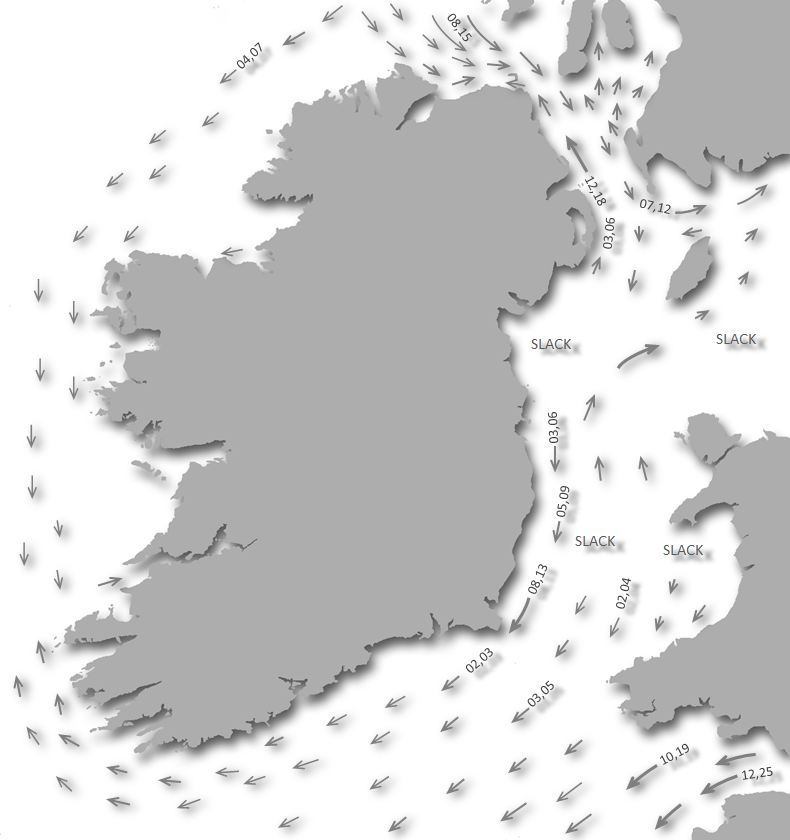
The Little Saltee Island Landing Beach entry provides island information.From a boating perspective, this is another excellent Little Saltee Island lunch stop or tide wait location for those who do not want to commit to the time or expense of entering Kilmore Marina. It is also close enough to St. Patrick’s Bridge to observe the precise turn of the tide so as to maximise the route
‘eight hours of a following tide from Kilmore Quay; east or westbound’.What facilities are available?
There are no facilities on Little Saltee Island and this anchorage offers no landing capability. Immediately ashore Kilmore Quay has all facilities.Any security concerns?
Security issues are unheard of on the Saltee Islands. In fact if anything the reverse is more likely to be encountered. Local boatmen are very welcoming and you can take it that they will by good nature be keeping an eye on the welfare of your vessel, should she drag whilst you are ashore, and be ready to assist you.With thanks to:
Burke Corbett, Gusserane, New Ross, Co. Wexford. Photography with thanks to Michael Harpur and Burke Corbett._county_wexford_ireland_DSC_0498.jpg)
_county_wexford_ireland_1. lokking ashoore weest.JPG)
_county_wexford_ireland_2. east of little saltee anchorage copy.jpg)
_county_wexford_ireland_3. south view copy.jpg)
About Little Saltee (east side)
The Little Saltee Island Landing Beach
entry provides island information.From a boating perspective, this is another excellent Little Saltee Island lunch stop or tide wait location for those who do not want to commit to the time or expense of entering Kilmore Marina. It is also close enough to St. Patrick’s Bridge to observe the precise turn of the tide so as to maximise the route
‘eight hours of a following tide from Kilmore Quay; east or westbound’.Other options in this area
Click the 'Next' and 'Previous' buttons to progress through neighbouring havens in a coastal 'clockwise' or 'anti-clockwise' sequence. Alternatively here are the ten nearest havens available in picture view:
Coastal clockwise:
Little Saltee (west side) - 0.3 miles WKilmore Quay - 1.3 miles N
Great Saltee (landing beach) - 0.9 miles SW
Gilert Bay - 1 miles SW
Georgina’s Bay - 1.2 miles SW
Coastal anti-clockwise:
Little Saltee (landing beach) - 0.3 miles NWCarne - 5.9 miles ENE
Ballytrent - 6.3 miles ENE
Rosslare Europort (Rosslare Harbour) - 7 miles NE
Rosslare Bay (or South Bay) - 6.8 miles NE
Navigational pictures
These additional images feature in the 'How to get in' section of our detailed view for Little Saltee (east side).


| Detail view | Off |
| Picture view | On |
 A photograph is worth a thousand words. We are always looking for bright sunny photographs that show this haven and its identifiable features at its best. If you have some images that we could use please upload them here. All we need to know is how you would like to be credited for your work and a brief description of the image if it is not readily apparent. If you would like us to add a hyperlink from the image that goes back to your site please include the desired link and we will be delighted to that for you.
Add your review or comment:
Please log in to leave a review of this haven.
Please note eOceanic makes no guarantee of the validity of this information, we have not visited this haven and do not have first-hand experience to qualify the data. Although the contributors are vetted by peer review as practised authorities, they are in no way, whatsoever, responsible for the accuracy of their contributions. It is essential that you thoroughly check the accuracy and suitability for your vessel of any waypoints offered in any context plus the precision of your GPS. Any data provided on this page is entirely used at your own risk and you must read our legal page if you view data on this site. Free to use sea charts courtesy of Navionics.