

The bay provides a tolerable anchorage in west round to north winds and in settled weather. Access is straightforward from the east as there are no outlying dangers and there is a good depth of water all the way into the shore.


Keyfacts for Ballytrent


Nature


Considerations

Protected sectors


Summary
A tolerable location with straightforward access.Nature
Considerations
Position and approaches

Haven position
 52° 12.867' N, 006° 20.282' W
This is just outside the 2 metre LAT contour and about 200 metres off the beach.
What is the initial fix?
 52° 12.750' N, 006° 19.400' W



What are the key points of the approach?
 .
.- Vessels approaching from the north should keep outside the Splaugh Rock Buoy.
- Vessels approaching from the south should keep outside the Fundale Rock Buoy.
- Pass to the north of Whilkeen Rock to approach the bay.
- Do not be tempted to cut inside Whilkeen Rock from the south as it is foul to the shore.
Not what you need?
- Carne - 0.9 nautical miles SSW
- Rosslare Europort (Rosslare Harbour) - 2.3 nautical miles N
- Rosslare Bay (or South Bay) - 2.4 nautical miles NNW
- Wexford Harbour - 8.7 nautical miles NNW
- Kilmore Quay - 9.5 nautical miles WSW
- Little Saltee (east side) - 10.1 nautical miles WSW
- Little Saltee (landing beach) - 10.2 nautical miles WSW
- Little Saltee (west side) - 10.5 nautical miles WSW
- Great Saltee (landing beach) - 11.5 nautical miles WSW
- Gilert Bay - 11.7 nautical miles WSW
- Carne - 0.9 miles SSW
- Rosslare Europort (Rosslare Harbour) - 2.3 miles N
- Rosslare Bay (or South Bay) - 2.4 miles NNW
- Wexford Harbour - 8.7 miles NNW
- Kilmore Quay - 9.5 miles WSW
- Little Saltee (east side) - 10.1 miles WSW
- Little Saltee (landing beach) - 10.2 miles WSW
- Little Saltee (west side) - 10.5 miles WSW
- Great Saltee (landing beach) - 11.5 miles WSW
- Gilert Bay - 11.7 miles WSW

Chart

What's the story here?
 The historic auxiliary ketch Ilen anchored in Ballytrent Bay
Image: © Peter Scallan
Ballytrent is a small open bay located to the northeast of Carne and St Margret’s Bay on the southeast corner of County Wexford. It is about two miles south of Rosslare Harbour and three miles north of Carnsore Point.
 The beautiful east facing Ballytrent Beach
Image: Michael Harpur
The open clean bay provides shelter during moderate winds from north round through west, to west by southwest in ample water with good sand holding. It, however, offers little protection to the prevailing south-westerlies although the Whilkeen Rocks, with their shallows and foul ground connecting to the shoreline, help to break up the groundswell and particularly so at low water.
How to get in?
 Ballytrent Bay indenting the coast close north of Whilkeen Rock
Image: Michael Harpur
Vessels following the coast but standing well off need not sail directly for the bay's central initial fix. Those approaching from the south must approach Ballytrent Bay by passing to the north of Whilkeen Rock. Once Whilkeen Rock is sited, it is possible to pass it at a sensible margin to port and keep it to port as it is rounded to pass on into the bay from the north side of the rock.
 Whilkeen Rock
Image: Burke Corbett
It is foul from Whilkeen Rock to the shore and it is not possible to pass inshore of the rock for a southern approach nor, specifically, take a shortcut directly from Carne and St Margret’s Bay into Balllytrent Bay.
Vessels approaching from the north should keep well clear of Greenore Point and Splaugh Rock. When well clear od these turn into the bay when Whilkeen Rock is seen to the south and keep it on the port side for the final approach.
 Ballytrent House and its grove of trees from seaward
Image: Burke Corbett
 From the initial fix, steer west by northwest into the bay for ½ a mile. The anchoring area will be readily apparent on approach as it lies beneath a grove of trees which is the only significant group of trees along this stretch of coast. There is also a radio mast within the treeline and a house standing close north.
 The anchoring area off of the beach
Image: Michael Harpur
Anchor according to draft and conditions in sand. Land on the beach by tender.Why visit here?
Ballytrent, in Irish 'Baile Treaint', meaning Baile 'townland, town, homestead' of Treaint. This name is believed to be an English surname 'Trant' or 'de Treant' meaning 'of Trent, a parish in Somerset, or place in Dorset'. Alternatively, it could be from Trewent in Pembrokeshire. This would make it one of the very few Irish names in South Wexford that contains an Anglo-Norman component. Ballytrent Bay
Image: Michael Harpur
Ballytrent’s strategic importance dates back to The Early Middle Ages as is evidenced by the Mulgrave Ráth situated immediately above the beach. Ráths or ringforts are circular fortified settlements that were mostly built in Ireland during the period leading up to the 10th century. Although found throughout Northern Europe they are a particularly prominent feature of the Irish landscape. 40,000 ringfort sites have been identified in Ireland, and it is thought that possibly as many as 50,000 existed of which many have been destroyed by farming and urbanisation. These fortifications came in many sizes and may be made of stone or earth. Earthen ringforts would have been marked by a circular rampart, a bank and a ditch, often with a stake wall. Both stone and earthen ringforts would generally have had at least one building inside. In the Irish language, these fortifications are known by a number of names but mostly ráth, anglicised 'rath', and 'dún' anglicised 'dun' or 'doon'. The 'ráth' and 'lios' was an earthen ringfort; the 'ráth' being the enclosing bank and the 'lios' being the open space within. The term 'dún' was usually reserved for a stronghold of importance, which may or may not be ring-shaped.

The ringfort, mast and grove are all part of the grounds of the beautiful Ballytrent House. This 18th-century heritage house was once home to one of Ireland’s most famous nationalist politicians John Redmond 1856 - 1918. John Edward Redmond was a barrister and MP in the House of Commons who succeeded Parnell as leader of the Nationalist Party from 1900 to 1918. His parents were descended from dispossessed Catholic gentry who turned to commerce and banking in the 18th century. They thrived and used the resulting wealth to acquire a sizable amount of land in County Wexford that included Ballytrent House in 1799. By the time of John’s birth, the family had become a respected, prominent local landholding family and a member of a small Catholic elite that was disproportionately concentrated in the southeast of Ireland.
 John Redmond
Image: Public Domain
This unusual family backdrop was to shape his nature and later political views. It created a moderate, constitutional and conciliatory politician who believed in proper relationships between Catholics and Protestants, nationalists and unionists alike in Ireland. It would have also kept him very much outside of the claustrophobic 'all-things-Irish' and the 'closed-in-thinking' that may have suffocated many of his party colleagues. Through this disposition, he attained his two-lifetime objectives; party unity and finally, in September 1914, the promise of Irish Home Rule under an Act that granted an interim form of self-government to Ireland. Implementation of the Act was to be suspended by the intervention of World War I and ultimately made untenable after the Conscription Crisis of 1918. Nevertheless, John Redmond should be counted amongst Ireland’s greatest political leaders.
 Ballytrent Beach it today as it was when John Redmond walked it
Image: Michael Harpur
Today Ballytrent offers a lovely beach upon which to let a family off to run and play. Being east facing, it is easily landed upon when the swell is not getting into the bay. They will play in the Redmond family’s footsteps and look out to seaward, as would have, over Tuskar Rock lighthouse that has been lighting this corner of Ireland since 1815. The well-sheltered Ballytrent beach is served by a single road and is very popular, by Irish standards, during the summer.
 Tuskar Rock Lighthouse as seen from Ballytrent Beach
Image: Michael Harpur
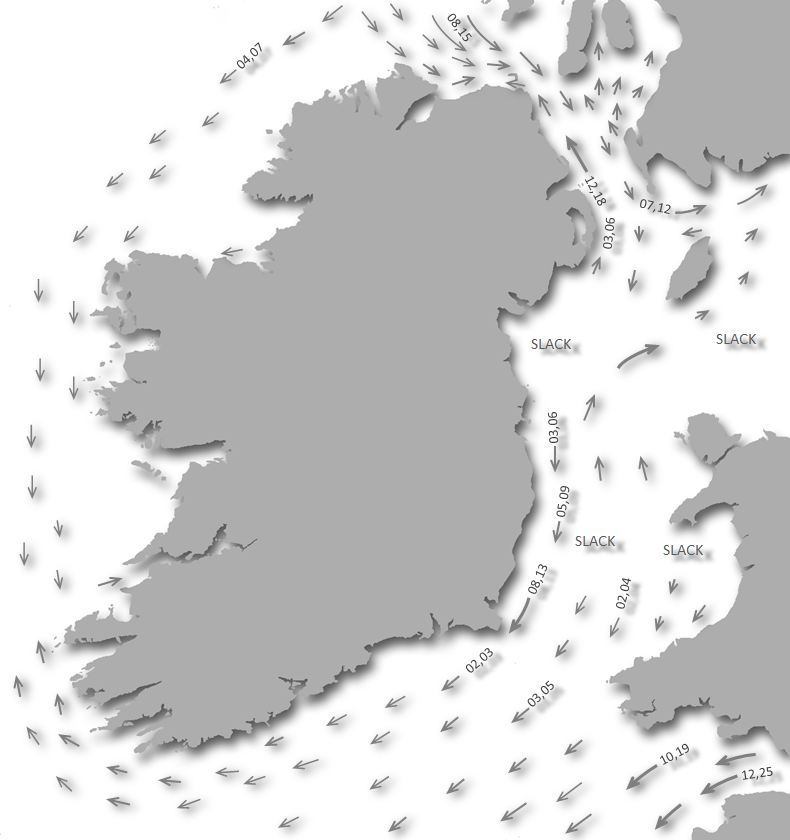
From a boating point of view, it is a secluded and convenient deep anchorage conveniently situated about midway between Greenore and Carnsore points. It is a useful place to sit and wait for a favourable tide before moving on.
 Ilen as seen from the Ballytrent beach
Image: © Peter Scallan
In settled weather, or when the bay is sheltered, a good night’s sleep could almost be guaranteed. But it would be exposed if the weather was to suddenly change.
What facilities are available?
The secluded beach has no facilities.Any security concerns?
Never an issue known to have occurred to a vessel anchored off Ballytrent.With thanks to:
Burke Corbett, Gusserane, New Ross, Co. Wexford.

 A photograph is worth a thousand words. We are always looking for bright sunny photographs that show this haven and its identifiable features at its best. If you have some images that we could use please upload them here. All we need to know is how you would like to be credited for your work and a brief description of the image if it is not readily apparent. If you would like us to add a hyperlink from the image that goes back to your site please include the desired link and we will be delighted to that for you.
Add your review or comment:
Patrick Sawyer wrote this review on Feb 13th 2020:
Michael. I have spoken with you in the past. I always tell people about your website, since I live about 70 meters from Ballytrent Beach, and see and know most of the regulars/locals and others.
However, "There are no facilities off this beach apart from a small seaside shop."
I have lived down here from Dalkey over six-and-a-half years, I know of no shop, though my landlord keeps pressing me to open something similar. Anyway, it is only during the summer, and especially weekends, a shop would be viable, business wise.
Michael, you provide an excellent site and service. Cheers
Patrick
Michael Harpur wrote this review on Mar 16th 2020:
Hi Patrick,
Thank you for your insight. I just dropped in to do some aerials and there was absolutely no trace of a shop ever been in existence. I have updated now and added the new images. Thank you for your insight and for spreading the word, because a wonderful resource simply may as well not exist, if who don not know about it. Thank you again.
Please log in to leave a review of this haven.
Please note eOceanic makes no guarantee of the validity of this information, we have not visited this haven and do not have first-hand experience to qualify the data. Although the contributors are vetted by peer review as practised authorities, they are in no way, whatsoever, responsible for the accuracy of their contributions. It is essential that you thoroughly check the accuracy and suitability for your vessel of any waypoints offered in any context plus the precision of your GPS. Any data provided on this page is entirely used at your own risk and you must read our legal page if you view data on this site. Free to use sea charts courtesy of Navionics.