

The secluded bay offers a tolerable anchorage in settled westerly conditions but can be subject to an uncomfortable swell. Daylight access is straightforward from the east as it is completely unimpeded.


Keyfacts for Seal Hole Bay
Facilities
None listedNature


Considerations

Protected sectors

Approaches

Shelter

Last modified
November 13th 2020 Summary* Restrictions apply
A tolerable location with straightforward access.Facilities
None listedNature
Considerations
Position and approaches

Expand to new tab or fullscreen
Haven position
 53° 29.322' N, 006° 0.400' W
Off the cliffs in Seal Hole Bay
What is the initial fix?
The following Seal Hole Bay will set up a final approach:
 53° 29.307' N, 005° 59.680' W



What are the key points of the approach?
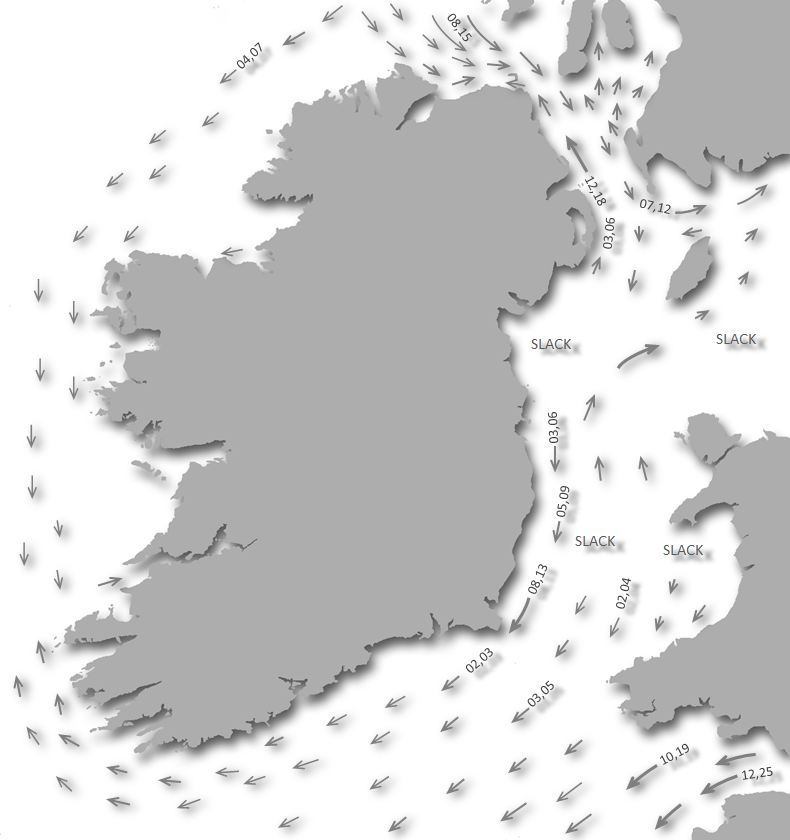
Offshore details are available in eastern Ireland’s Coastal Overview for Strangford Lough to Dublin Bay  .
.
.- Pass outside the marked dangers on the northwest and southwest corners of the island.
- Come in bearing due west and anchor under the cliffs.
Not what you need?
Click the 'Next' and 'Previous' buttons to progress through neighbouring havens in a coastal 'clockwise' or 'anti-clockwise' sequence. Below are the ten nearest havens to Seal Hole Bay for your convenience.
Ten nearest havens by straight line charted distance and bearing:
- Saltpan Bay - 0.7 nautical miles NW
- Talbot’s Bay - 0.9 nautical miles W
- The Boat Harbour - 1 nautical miles WNW
- Rush Harbour - 3.3 nautical miles NW
- Rogerstown Inlet - 4.2 nautical miles WNW
- Loughshinny - 4.3 nautical miles NW
- Malahide - 5.6 nautical miles WSW
- Carrigeen Bay - 5.6 nautical miles SSW
- Howth - 6.1 nautical miles SSW
- Balscadden Bay - 6.4 nautical miles SSW
These havens are ordered by straight line charted distance and bearing, and can be reordered by compass direction or coastal sequence:
- Saltpan Bay - 0.7 miles NW
- Talbot’s Bay - 0.9 miles W
- The Boat Harbour - 1 miles WNW
- Rush Harbour - 3.3 miles NW
- Rogerstown Inlet - 4.2 miles WNW
- Loughshinny - 4.3 miles NW
- Malahide - 5.6 miles WSW
- Carrigeen Bay - 5.6 miles SSW
- Howth - 6.1 miles SSW
- Balscadden Bay - 6.4 miles SSW

Chart

What's the story here?
 Seal Hole Bay in the southwest side of Lambay Island
Image: Михал Орела via CC BY-SA 2.0
Seal Hole Bay is a large southwest facing bay set within a large indent at about the middle of Lambay Island’s eastern side. The bay is more than ½ a mile wide and its northern arm is the northeast most point of Lambay, called the 'Nose of Lambay', a 55 metres high rocky point.
The entire bay has unimpeded access when approached from due east at right angles to the shoreline. It offers a temporary remote anchorage close-in to the rocks in 3 or 4 metres over sand.
How to get in?
 Lambay and Seal Hole Bay as seen from the east
Image: Михал Орела via CC BY-SA 2.0
 Ireland’s Coastal Overview from Strangford Lough to Dublin Bay provide approach details. Vessels approaching from the south can also avail of the Dublin Bay to Rosslare Harbour coastal overview. Use the Lambay Island descriptions provided for The Boat Harbour
  for approaches to the island area.
  Come in westward from the initial fix set ½ outside the anchoring area just inside the 20-metre contour. The bay which is made up of high cliffs has at least 10 metres of water 200 metres off the shoreline. Sound in and anchor off in 3 to 4 metres in sand.
 Why visit here?
Lambay Island derives its name from the Viking word 'Lamb', meaning 'Ewe' and 'ey', meaning island; 'Ewe Island'. But Lambay's ancient Irish name was 'Reachra' meaning 'place of many shipwrecks'. RMS Tayleur in full sail
Image: Public Domain
This ancient name is tragically demonstrated in more modern times by the sad events surrounding the RMS Tayleur that occurred just southwest of 'The Nose' on the east side. RMS Tayleur was a 1,979 ton ironclad clipper chartered by the White Star Line. In the 1850s gold was discovered in Australia and RMS Tayleur was thought to be the perfect means to good fortune. The clipper was the largest, the fastest and the most technically advanced sailing merchantman built at that time in England. With three 45 metres high masts the vessel was built for speed rather than manoeuvrability. The ship departed the Mersey on her maiden voyage from Liverpool to Melbourne on the 19th of January 1854. Aboard it had 579 emigrants, 80% of whom were Irish, bound for the Goldfields of Australia.
 The Nose in better conditions
Image: Brian Lennon
48 hours later at 11 am on Saturday morning, in thick weather and uncertain of their position, the black rocks of Lambay Island were suddenly sighted less than a mile ahead. Her captain, Captain Noble, desperately tried to turn the ship but the wind and strong tide pushed and pulled the vessel towards the rocks. Amidst chaos on the deck, the crew hauled frantically on its halyards to reef the sails but the lines jammed. The wheel went hard over but the ship refused to turn. The captain then ordered both anchors to be dropped and chains snapped 'like glass' leaving the ship racing onward at sickening speed.
With all his remedial actions unsuccessful the resigned captain aimed the prow as best he could so that the ship would hit the side of the jagged rock as a desperate last resort to provide the passengers with a chance to scramble to safety. Then, 30 minutes from first sighting land, with a sicking thud that shook the ship 'from stem to stern', the Tayleur struck the rocks of Lambay. She rose on a wave, then struck again, and again, and quickly began to sink, stern first into the shallow water. The ship died against the rocks within another 30 minutes.
 RMS Tayleur depicted after running up on Lambay Island
Image: Public Domain
On deck, the passengers, many still in their nightclothes, rushed to find the once mighty ship awash and sinking beneath them into the wintry seas. Some passengers scrambled ashore, others slid down a rope. The survivors were then faced with having to get up an almost sheer 24-metre high cliff to get to shelter. Numbers of lives lost vary, as do the numbers given as to how many were on board. Those aboard are believed to be between 528 and 680, while the dead are supposed to be at least 297, and up to 380, depending on the source. Whichever number is used, the loss was vast and more than half of all the souls aboard, something that shocked the Victorian world.
Of the emigrants aboard, there were an estimated 250 women and children, yet only 3 of the women survived. Escape from the ship at this critical point favoured those with greater physical capability, so women and children featured disproportionately among the dead. A fatality rate that was possibly exacerbated by feminine clothing of that era. A child survivor who stayed alive in the water tied to a plank for 24 hours, became known as the Ocean Wonder and was eventually adopted by a woman who had lost her whole family in Tayleur Bay. Bodies littered the shoreline for weeks after.
 RMS Tayleur depicted as she starts to break up
Image: Public Domain
A three-day inquest into the tragedy, that would in retrospect be called the White Star Line's first Titanic, was held in the newly opened Grand Hotel in Malahide. There were many contributing reasons for the Tayleur tragedy. The vessel had not been turned fully laden with cargo before it left the Mersey. The compass had been reacting to the vessels iron cladding and no one had yet worked out how to correct it - 'magnetic deviation' was less understood at the time than 'magnetic variation' as Iron ships were a new technology. The rudder was undersized for her tonnage so that she was unable to tack around the island. The rigging was also faulty; the ropes had not been properly stretched, so that they became slack, making it nearly impossible to control the sails. The ship had all these faults going to sea because it was not customary for ships at the time to undergo sea trials before their maiden voyage.
 Tayleur Bay so named today, just south west of The Nose, site of the wreck
Image: Brian Lennon
In addition to all of these findings, the ship was undermanned and had an inexperienced crew. Worse, the crew were mostly of Chinese origin who were more interested in a passage to the goldfields of Australia than a career at sea. Language problems, compounded by inexperience, meant that they simply didn't understand the Captain's orders much of the time. The captain, on the other hand, who made superhuman efforts to keep the ship afloat, and was one of the last off of the vessel, was exonerated and had his certificate renewed.
A memorial to those killed in the wreck was unveiled at Portrane on 16th May 1999. The ship was rediscovered in 1959 by sub-aqua divers who salvaged huge quantities of artefacts from the wreck. Tayleur's binnacle and bell are to be seen today in the Civic and Maritime Museum in Dún Laoghaire. She lies in 17 metres depth some 30 metres off 'The Nose' in a small southern indentation that has come to be known as Tayleur Bay. This is located about 800 metres to the northeast of Seal Hole.
Frequented by many a dive boat the bay offers another temporary anchorage on Lambay. It is a place where nature lovers can enjoy the largest concentration of grey seals on the East coast of Ireland. There are several caves in the cliffs much frequented for giving birth to their pups.
What facilities are available?
There are no facilities on the island and no landing should take place. The island is privately owned by the Revelstoke family and the owners value their privacy.Any security concerns?
Never an issue known to have occurred anchored off this private offshore island. Vessels are most likely to be alone or in the company of other anchored yachtsmen.With thanks to:
Brian Lennon local sailor. Photography with thanks to Brian Lennon.Gill Hoffs talks to Jimmy Wagg on BBC Radio Manchester about her book 'The Sinking of RMS Tayleur:
Dive on the wreck of RMS Tayleur at Lambay Ireland


 A photograph is worth a thousand words. We are always looking for bright sunny photographs that show this haven and its identifiable features at its best. If you have some images that we could use please upload them here. All we need to know is how you would like to be credited for your work and a brief description of the image if it is not readily apparent. If you would like us to add a hyperlink from the image that goes back to your site please include the desired link and we will be delighted to that for you.
Add your review or comment:
Please log in to leave a review of this haven.
Please note eOceanic makes no guarantee of the validity of this information, we have not visited this haven and do not have first-hand experience to qualify the data. Although the contributors are vetted by peer review as practised authorities, they are in no way, whatsoever, responsible for the accuracy of their contributions. It is essential that you thoroughly check the accuracy and suitability for your vessel of any waypoints offered in any context plus the precision of your GPS. Any data provided on this page is entirely used at your own risk and you must read our legal page if you view data on this site. Free to use sea charts courtesy of Navionics.