

Copeland Marina is located on the northeast coast of Ireland, close outside the southern entrance to Belfast Lough and immediately south of Donaghadee Harbour. It is a small very tight marina that sets aside a small number of visitor berths in the sailing season.
The marina offers complete protection behind its high surrounding walls and a tide gate which can be fully raised in the event of strong onshore winds. Careful navigation is required for the final length of the approach, that although well marked, is tightly bounded by rocks and the entrance itself is very narrow. Access is also only available at the top end of the tide to clear a drying sill at the entrance.


Keyfacts for Copelands Marina


Last modified
November 18th 2022 Summary* Restrictions apply
A completely protected location with careful navigation required for access.Facilities


Nature


Considerations


Position and approaches

Expand to new tab or fullscreen
Haven position
 54° 38.437' N, 005° 31.750' W
At the entrance to the marina.
What is the initial fix?
The following Copelands Marina Initial Fix will set up a final approach:
 54° 38.440' N, 005° 31.420' W



What are the key points of the approach?
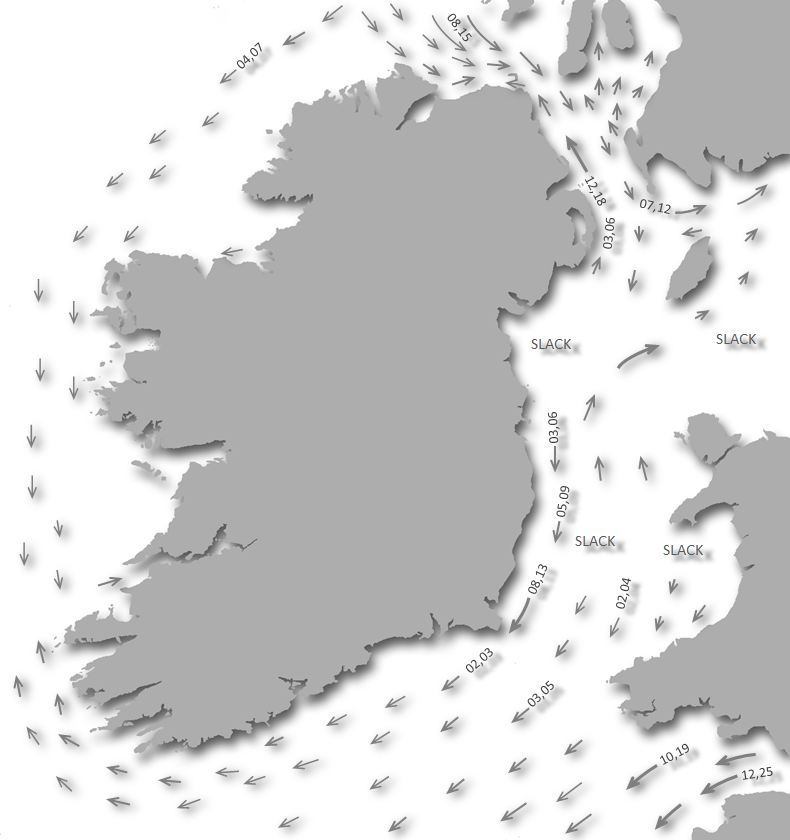
Offshore details are available in the northeast Ireland’s Coastal Overview for Malin Head to Strangford Lough  and the Donaghadee Sound for local tidal optimisations.
and the Donaghadee Sound for local tidal optimisations.- From the south and east pass Mew and Copeland Islands well clear to starboard.
- From the north or Belfast Lough, with a favourable tide, pass between the south side of Copeland Island and the mainland coast in the well-marked fairway channel.
- Make certain that a berth is available and there is sufficient depth over the entrance sill before an approach is attempted.
- Find the marina and track in on its two leading marks in line 276° T marked by orange triangles on poles with the front close to the entrance and the rear close behind.
Not what you need?
Click the 'Next' and 'Previous' buttons to progress through neighbouring havens in a coastal 'clockwise' or 'anti-clockwise' sequence. Below are the ten nearest havens to Copelands Marina for your convenience.
Ten nearest havens by straight line charted distance and bearing:
- Donaghadee Harbour - 0.3 nautical miles NNW
- Chapel Bay - 1.9 nautical miles N
- Port Dandy - 2.2 nautical miles NNW
- Groomsport - 3.8 nautical miles NW
- Ballyholme Bay - 4.6 nautical miles WNW
- Bangor Harbour & Marina - 5.2 nautical miles WNW
- Ballywalter - 6.5 nautical miles SSE
- Helen’s Bay - 7.4 nautical miles WNW
- Kircubbin - 9 nautical miles S
- Whitehead - 9 nautical miles NW
These havens are ordered by straight line charted distance and bearing, and can be reordered by compass direction or coastal sequence:
- Donaghadee Harbour - 0.3 miles NNW
- Chapel Bay - 1.9 miles N
- Port Dandy - 2.2 miles NNW
- Groomsport - 3.8 miles NW
- Ballyholme Bay - 4.6 miles WNW
- Bangor Harbour & Marina - 5.2 miles WNW
- Ballywalter - 6.5 miles SSE
- Helen’s Bay - 7.4 miles WNW
- Kircubbin - 9 miles S
- Whitehead - 9 miles NW


What's the story here?
 Copelands Marina
Image: Michael Harpur
Copelands Marina is located 2 miles south of Copeland Island and immediately south of Donaghadee Harbour. It is a small privately owned and family-run marina enclosed within a basin in a former quarry cut that was cut into the rocky foreshore of Meetinghouse Point. Enclosed within the original high walls of the quarry the marina has significant protection. At the entrance to the marina, there is a sill to be cleared and the entrance channel is also very narrow and rocks on either side. Careful pilotage is required for the approach and good offshore conditions, but it is very well-marked.
 Copelands marina as seen from the south
Image: Michael Harpur
The sill dries to 1 metre above LAT and 1.5 metres can be expected at half tide. Inside there are berths for up to 90 craft on pontoons piles. The marina accommodates vessels of up to 11 metres LOA and normally sets aside six berths for visiting boats. However, it is a popular location so it is highly advisable to make berthing arrangements in advance. The Copelands Marina Manager, Gerald Nicholas, can be reached on
 Ch. 16, 11 & 80 [Copelands Marina],
  +44 2891 992184,
  +44 7802 36 3382,
  gerald.nicholas@o2.co.uk.
How to get in?
 Copelands Marina with Donaghadee Harbour and the Copeland Islands in the
backdrop
Image: Michael Harpur
 Use the details available in the northeast Ireland’s Coastal Overview for Malin Head to Strangford Lough for local approaches and the Donaghadee Sound for local tidal optimisations. The marina is located 400 metres south of the Donaghadee Harbour which is made conspicuous by its tower and the marina by its walls.
 The southern approaches to Copelands Marina
Image: Michael Harpur
Marina access is HW +/- 3 hours depending upon draft. Expect about 1.5 metres over the sill at half-tide, making it advisable for moderate to deep vessels to seek advice from the Marina Manager on how to clear the sill on the day of approach.
Although tight, the marina's access path and entrance are very well-marked. If there are any concerns the option is always available to temporarily come into Donaghadee town harbour and stroll around to inspect the marina layout and approaches personally. But do not be tempted to come round the head of the South Pier and steer directly along the coast to approach the marina.
 The area between Donaghadee Harbour and Copeland Marina is foul
Image: Michael Harpur
The entire area between Donaghadee Harbour and Copeland Marina is occupied by outlying coastal rocks that cover at high water. It is therefore essential to head out to sea from Donaghadee and come back into the marina from eastward.
 The leading marks for Copelands Marina as seen from eastward
Image: Michael Harpur
 From the initial fix the marina entrance will be visible about 400 metres away. The marina’s seawall has a large painted sign with an arrow that indicates the position of the entrance on its northern side.
  The leading marks for Copelands Marina as seen from southward
Image: Michael Harpur
Stay outside the 10-metre contour, about 300 – 400 metres out, until the leading marks are positively identified. These are two conspicuous orange triangles on poles close north of the entrance. They are close north of the entrance with the front on the gravelly foreshore and the rear, higher up, on the fence of the boat park close behind. In line, they mark the fairway on a bearing 276° T. The track is further supported by a starboard perch making the extremity of the rock on the north side of the channel.
 The starboard perch as seen from the foreshore
Image: Michael Harpur
Once identified track in steadily keeping the leading marks on transit. The latter inshore half of that distance will be between drying rocks, and the final stretch is particularly narrow. Keep the orange triangular marks in line in the entrance channel, then follow the concrete quay under the wall on the edge of the channel that leads into the marina. Once the marina entrance and its sill opens turn sharp to port.
 The entrance to Copelands Marina
Image: Michael Harpur
Berth on pontoon piles as directed. Berthed vessels in Copelands Marina
Image: Michael Harpur
Why visit here?
Copelands Marina takes its name from the islands it overlooks. The origins of the name are from Old Norse 'Kaupmennayer' meaning 'merchant land' or 'bought land' a feature worthy of note during the early Middle Ages, when the land was rarely sold, but held by feudal tenure and handed down from one generation to the next. This became shortened to Copman over time. Coplands Marina takes its name from the islands it overlooks
Image: Michael Harpur
However, the Copeland Islands most likely derive their name from the de Coupland family who arrived here in 1183 as part of the Norman invasion and settled in the Newtownards area. The Anglo-Norman family lent them their name as is the case with Copeland Water near Carrickfergus and the townland of Ballycopeland in the civil parish of Donaghadee.
 Donaghadee c.1914
Image: The Public Record Office of Northern Ireland (PRONI) CC01
The marina came about as a consequence of the construction of the massive walls and lighthouse of the adjacent Donaghadee Harbour
 in the 1820s. The outer walls and back slopes were all made from the local dark 'greywacke' stone. This was blasted from the seabed within the harbour area and from, what was then called, the 'Quarry Hole' at Meetinghouse Point which could be conveniently taken by boat to the site. The harbour’s beautiful inner faces were made from limestone taken from the Moelfre quarries of Angelsey, in north Wales, and it is this 'Anglesea marble' with the finest ashlar dressing that has made the handsome piers a lasting triumph. The original 'Quarry Hole' was established in 1977 as Copelands Marina which perhaps makes it the oldest marina, as we would define it today, in Ireland.
 The marina was originally called 'Quarry Hole' as its stone was used to build
Donaghadee Harbour
Image: Michael Harpur
From a boating point of view, Copelands Marina is within a day's sail, and sometimes in sight of the Scottish coast and the Isle of Man. It is an ideal destination to enjoy the historic town of Donaghadee and the Ard’s Peninsula and is completely protected behind the marina’s high-sided walls and the tidal gate should strong easterlies develop.
What facilities are available?
Marina berths have water, electricity, toilets, and showers; and a 20 tonnes capacity crane and some repair work are available locally. Donaghadee is very convenient as shops, pubs and restaurants which serve the local population in excess of six thousand, are easily reached within a small area local to the harbour. Donaghadee Sailing Club welcomes visitors and is open Wednesday, Friday and Sunday.The harbour is about 29 km (18 miles) from Belfast and about 13 km (8 miles) northeast of Newtownards. A bus service is available to Belfast that offers connections to any location in Ireland. Likewise flights to domestic and international destinations operate from Belfast City and Belfast International Airports. There are frequent ferry crossings from Belfast and Larne.
Any security concerns?
The marina is a secured area.With thanks to:
Charlie Kavanagh - ISA/RYA Yachtmaster Instructor/Examiner.About Copelands Marina
Copelands Marina takes its name from the islands it overlooks. The origins of the name are from Old Norse 'Kaupmennayer' meaning 'merchant land' or 'bought land' a feature worthy of note during the early Middle Ages, when the land was rarely sold, but held by feudal tenure and handed down from one generation to the next. This became shortened to Copman over time.
Coplands Marina takes its name from the islands it overlooksImage: Michael Harpur
However, the Copeland Islands most likely derive their name from the de Coupland family who arrived here in 1183 as part of the Norman invasion and settled in the Newtownards area. The Anglo-Norman family lent them their name as is the case with Copeland Water near Carrickfergus and the townland of Ballycopeland in the civil parish of Donaghadee.
Donaghadee c.1914Image: The Public Record Office of Northern Ireland (PRONI) CC01
The marina came about as a consequence of the construction of the massive walls and lighthouse of the adjacent Donaghadee Harbour
in the 1820s. The outer walls and back slopes were all made from the local dark 'greywacke' stone. This was blasted from the seabed within the harbour area and from, what was then called, the 'Quarry Hole' at Meetinghouse Point which could be conveniently taken by boat to the site. The harbour’s beautiful inner faces were made from limestone taken from the Moelfre quarries of Angelsey, in north Wales, and it is this 'Anglesea marble' with the finest ashlar dressing that has made the handsome piers a lasting triumph. The original 'Quarry Hole' was established in 1977 as Copelands Marina which perhaps makes it the oldest marina, as we would define it today, in Ireland.The marina was originally called 'Quarry Hole' as its stone was used to buildDonaghadee Harbour
Image: Michael Harpur
From a boating point of view, Copelands Marina is within a day's sail, and sometimes in sight of the Scottish coast and the Isle of Man. It is an ideal destination to enjoy the historic town of Donaghadee and the Ard’s Peninsula and is completely protected behind the marina’s high-sided walls and the tidal gate should strong easterlies develop.
Other options in this area
Click the 'Next' and 'Previous' buttons to progress through neighbouring havens in a coastal 'clockwise' or 'anti-clockwise' sequence. Alternatively here are the ten nearest havens available in picture view:
Coastal clockwise:
Ballywalter - 4 miles SSEBallyhalbert Bay - 5.8 miles SSE
Portavogie Harbour - 7.1 miles SSE
Portaferry - 9.7 miles S
Ballyhenry Bay - 9.4 miles S
Coastal anti-clockwise:
Donaghadee Harbour - 0.2 miles NNWChapel Bay - 1.2 miles N
Port Dandy - 1.4 miles NNW
Groomsport - 2.3 miles NW
Ballyholme Bay - 2.8 miles WNW
Navigational pictures
These additional images feature in the 'How to get in' section of our detailed view for Copelands Marina.


| Detail view | Off |
| Picture view | On |
 A photograph is worth a thousand words. We are always looking for bright sunny photographs that show this haven and its identifiable features at its best. If you have some images that we could use please upload them here. All we need to know is how you would like to be credited for your work and a brief description of the image if it is not readily apparent. If you would like us to add a hyperlink from the image that goes back to your site please include the desired link and we will be delighted to that for you.
Add your review or comment:
Please log in to leave a review of this haven.
Please note eOceanic makes no guarantee of the validity of this information, we have not visited this haven and do not have first-hand experience to qualify the data. Although the contributors are vetted by peer review as practised authorities, they are in no way, whatsoever, responsible for the accuracy of their contributions. It is essential that you thoroughly check the accuracy and suitability for your vessel of any waypoints offered in any context plus the precision of your GPS. Any data provided on this page is entirely used at your own risk and you must read our legal page if you view data on this site. Free to use sea charts courtesy of Navionics.