

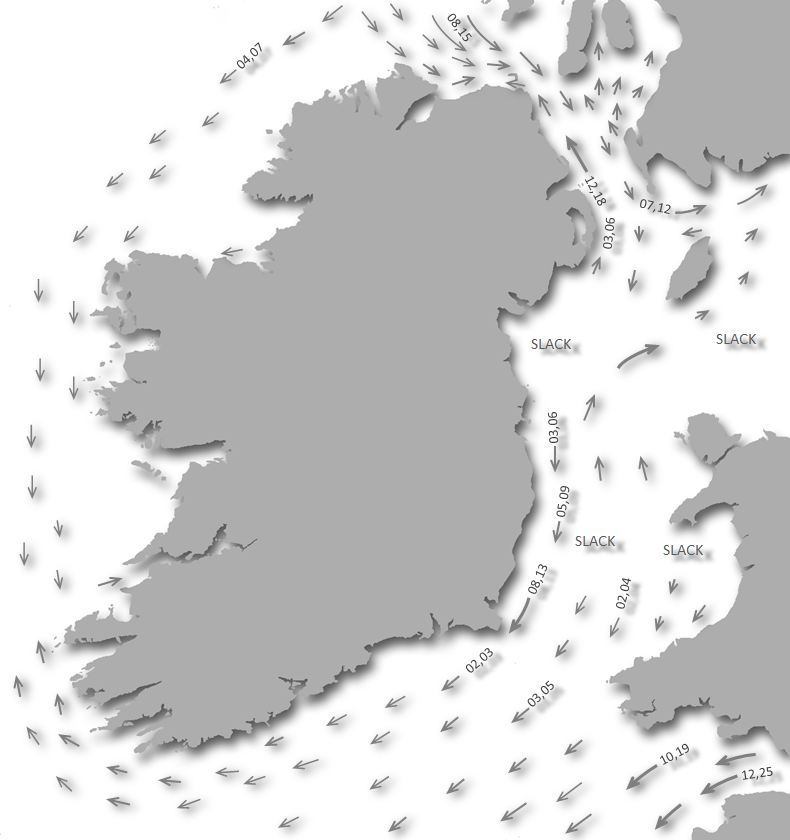
The bay’s relatively high and protective headland provides good shelter from southwest to severe westerly winds. In addition, there is little if any tidal movement within the bay and it provides good holding in clear sand. Navigation is straightforward as the bay has unhindered seaward access.


Keyfacts for Baginbun Bay
Facilities

Nature


Considerations
Protected sectors

Approaches

Shelter
Last modified
May 31st 2023 Summary
A good location with straightforward access.Facilities
Nature
Considerations
Position and approaches

Expand to new tab or fullscreen
Haven position
 52° 10.600' N, 006° 49.500' W
In the anchorage to the north of the headland.
What is the initial fix?
The following Baginbun Bay Initial Fix will set up a final approach:
 52° 10.820' N, 006° 48.495' W



What are the key points of the approach?
Offshore details are available in southeastern Ireland’s coastal overview for Rosslare Harbour to Cork Harbour  .
.
.Not what you need?
Click the 'Next' and 'Previous' buttons to progress through neighbouring havens in a coastal 'clockwise' or 'anti-clockwise' sequence. Below are the ten nearest havens to Baginbun Bay for your convenience.
Ten nearest havens by straight line charted distance and bearing:
- Fethard On Sea - 1 nautical miles N
- Bannow Bay - 1.8 nautical miles NNE
- Templetown Bay - 3 nautical miles W
- Lumsdin's Bay - 3.1 nautical miles WSW
- Dollar Bay - 3.4 nautical miles WNW
- Slade - 4 nautical miles SW
- Creadan Head - 4.7 nautical miles W
- Duncannon - 5 nautical miles WNW
- Arthurstown - 6.1 nautical miles NW
- Dunmore East - 6.3 nautical miles WSW
These havens are ordered by straight line charted distance and bearing, and can be reordered by compass direction or coastal sequence:
- Fethard On Sea - 1 miles N
- Bannow Bay - 1.8 miles NNE
- Templetown Bay - 3 miles W
- Lumsdin's Bay - 3.1 miles WSW
- Dollar Bay - 3.4 miles WNW
- Slade - 4 miles SW
- Creadan Head - 4.7 miles W
- Duncannon - 5 miles WNW
- Arthurstown - 6.1 miles NW
- Dunmore East - 6.3 miles WSW

Chart

What's the story here?
 Yacht anchored at Baginbun
Image: Michael Harpur
Baginbun is 6 miles northeast of Hook Head Lighthouse, on the eastern shore of the Hook Head peninsula and the west side of Ballytiege Bay. It is situated close north of Baginbun Head, which is made conspicuous by its Martello Tower. It offers an anchorage with good sand holding beneath a moderately high headland that provides protection from the prevailing winds.
How to get in?
 The headland is readily identified by Baginbun Martello Tower
 Image: Michael Harpur
 Use southeastern Ireland’s coastal overview for Rosslare Harbour to Cork Harbour for seaward approaches.
 Baginbun Tower seen from a boat close south
Image: Burke Corbett
Vessels working up close along the coast for the 5 miles between the Hook and Baginbun Head should be careful to avoid Brecaun Bridge. This is a reef situated approximately halfway between Hook Head and Baginbun Head, just under a mile east by north of the small drying harbour of Slade, itself readily identifiable by its square tower. Brecaun Bridge extends over ⅓ mile offshore, with a depth of 1.2 metres at its extremity.
 Brecaun Bridge just breaking, as seen from the north
Image: Michael Harpur
 From the initial fix set ½ mile to the northeast, the bay will be readily identifiable and the approach is clear of danger.
  Baginbun as seen from the east
Image: Michael Harpur
It is not necessary for a southern-approaching vessel to adopt the approach line suggested by the initial fix. It is, however, critical to keep well off Baginbun Head, as rocks extend out 600 metres to the northeast from the extremity. A useful local boatman’s waypoint for passing east of Baginbun Head is as follows.
Baginbun Head - clear water waypoint: 52° 10.450’ N, 006° 49.244’ W
This waypoint, or further east of it, will keep a vessel clear of the extending rocks from the headland.
 The anchoring area within the head
Image: Michael Harpur
Make towards a comfortable point beneath the headlands and drop anchor according to draught in clear sand. Land on the beach by tender.Why visit here?
On 1 May 1170, Baginbun was known as Dún Domhnaill because it was once an ancient defensive trading earthwork known as the ‘Fort of Domhnaill’, located across the neck of the secondary headland. On that particular day, any native Irish who happened to be there would have seen two boats approaching the headland and would have made ready to raise the alarm. The defences of the secondary headland are still visible
Image: Michael Harpur
It would not have been an exceptional event as the local people were accustomed to raiders along this coast, so they could have been forgiven for thinking it was just another passing incursion: this was very different, however. That day a new epoch in the nation’s history was bearing down on Baginbun from the sea. After Bannow Bay, this was the second coming of the most organised military machine the west had known to date – the Normans. It was from this Baginbun landing that the conquest of Ireland began in earnest.
 The beach upon which De Gros would have landed
Image: Michael Harpur
The Anglo-Norman force was led by Raymond (or Redmond) FitzGerald, who was a relative of the previous landing’s FitzStephen and FitzGerald, as well as Strongbow himself. Known as De Gros (Raymond the large), on account of his great size and strength, he was one of the most valiant and cunning of the Anglo-Norman commanders. His was the fourth landing in Ireland of the invasion force commanded by The Earl of Pembroke, Richard de Clare – better known as Strongbow: De Gros was his second in command. His mission was to secure a landing point for his leader’s fifth landing party and he chose Baginbun, knowing the old promontory fort could serve as a temporary defensive camp before he moved on to attack the nearby, well-defended Waterford.
 Raymond de Gros
Image: Michael Harpur
.jpg) Tomb effigy of Raymond De Gros at Molana Abbey (now lost)
Tomb effigy of Raymond De Gros at Molana Abbey (now lost)Image: Public Domain
De Gros first ordered his small force to launch a frontal attack on the army and then quickly retreat, feigning panic. The untrained Waterford men fell for this bait and, jubilant at the sight of the fleeing Normans, wildly charged after them out along the narrow promontory. With no armour and very poor improvised weapons, they ran unprotected, throwing stones after the seasoned Norman, Welsh and Flemish mercenary forces. When the pursuit unwittingly committed them to the narrow pass leading out to the headland, the Norman archers let fly and wave upon wave of helpless Irish defenders were cut down. Then De Gros stampeded out the massive heard of cattle through the following ranks, scattering them in disarray. Taking advantage of the confusion, the heavily armed knights followed hot on the hooves on the cattle, hacking and cleaving their way machine-like through the routed attackers. By the time the engagement was finished, the bodies of at least 500 Norse-Gaelic dead were strewn over the headland and a further 70 were taken prisoner. They fared little better.
Raymond had hoped to use them as bargaining chips to gain ransoms from various chieftains, but he was to be disappointed. At the time Norman Marcher Lords would take their lovers with them on a campaign, and this was the case of Alice of Abergavenny, who accompanied the landing party. Her knight was killed in the battle and, in a fit of rage, Alice took an axe and set about decapitating all 70 of the Irish prisoners. One by one she took off their heads and dumped their headless bodies over the cliff. For this hot-blooded act she received the name Alice the vicious. This was not uncommon: locals that were captured whilst the army remained on the headland for the following months had their legs broken and were hurled into the sea for sport.
 The Marriage of Strongbow and Aoife by Daniel Maclise
Image: Public Domain
De Gros finally departed Baginbun when Strongbow landed at Passage East on the 23 August with his larger and ultimately highly significant invasion force of 1,200 warriors. Two days later their combined forces took the City of Waterford in a bloodbath of an offensive. Aoife and Strongbow were married at Christ Church Cathedral soon after Waterford was seized. De Gros married Basilia de Clare, Strongbow’s sister, taking the office of standard-bearer of Leinster. He was for some time also chief Governor of Ireland. Raymond died around 1184 and was buried in the Abbey of Molana, on the island of Darinis, on the Blackwater River, in Youghal Bay.
 Departure of Henry II at Waterford
 Image: Public Domain
So, Ireland was receiving its taste of the Norman ferocity that had cut its way like a scythe through Europe and had routed the warriors of Harold’s England. Its message was cold and simple: “Acquiesce, or be annihilated”. Surprisingly, the battle fought on this remote headland Baginbun was one of the most pivotal moments of the Norman conquest of Ireland. Had De Gros’s small Norman force been wiped out, it is conceivable that Richard de Clare might have lost heart in the Irish enterprise in which he went on to play a key part. And as news of the Norman successes such as this reached England, more Norman warriors made their way to Ireland. Accordingly, it is thought that this was the decisive battle that would mark the beginning of 800 years of English, and later British, rule in Ireland, inspiring the couplet: “At the creek of Baginbun, Ireland was lost and won”.
 The peaceful Baginbun experienced today
Image: Michael Harpur
Today the extensive defensive earthworks and promontory fortifications that De Gros erected in Baginbun are still discernible. The bay’s very name originates back to the conjunction of the names of his two invading boats, Le Bag and Le Bun – ‘Bagin’-‘bun’. The strategic importance of the area was subsequently marked by the construction of the Lighthouse at Hook Head and Baginbun Head’s Martello Tower between 1804 and 1806, during the Napoleonic period.
 The Martello Tower, Baginbun’s last vestige of militarism, standing guard since Napoleonic times
Image: Michael Harpur
From a boating perspective, Baginbun remains little altered and is as good a haven for boaters today as it was for De Gros’s wise seamen. The raised ground above the little cove makes for a sheltered anchorage from which to endure severe southwest to westerly winds.
In addition, it offers a particularly beautiful clear sand and secluded beach, over which the headland provides an equal measure of prevailing wind protection for beachgoers as it does for offshore vessels. A short stroll over the headland presents the even more spectacular beach that lies within the shores of Carnivan Bay. The view from Carnivan Bay over to Slade and Hook Head is breath-taking.
What facilities are available?
There is little at Baginbun, save for a beach with no road access to the shoreline. A 20-minute or 2km walk along country lanes will take you to Fethard-on-Sea. This village is a tourist destination with a mini supermarket, fuel, café and bars.Any security concerns?
There has never been an issue known to have occurred at Baginbun.With thanks to:
Declan Hearne, Long term fisherman and retired area Coastguard leader. Photography with thanks to Burke Corbett and Michael Harpur.
Baginbun, County Wexford, Ireland
Image: eOceanic thanks Michael Harpur
.jpg)
The view northward along the beach
Image: eOceanic thanks Michael Harpur

The view southward along the beach
Image: eOceanic thanks Michael Harpur

Pinnacle rock midway along the beach
Image: eOceanic thanks Michael Harpur

View east from above the beach
Image: eOceanic thanks Michael Harpur


 A photograph is worth a thousand words. We are always looking for bright sunny photographs that show this haven and its identifiable features at its best. If you have some images that we could use please upload them here. All we need to know is how you would like to be credited for your work and a brief description of the image if it is not readily apparent. If you would like us to add a hyperlink from the image that goes back to your site please include the desired link and we will be delighted to that for you.
Add your review or comment:
Please log in to leave a review of this haven.
Please note eOceanic makes no guarantee of the validity of this information, we have not visited this haven and do not have first-hand experience to qualify the data. Although the contributors are vetted by peer review as practised authorities, they are in no way, whatsoever, responsible for the accuracy of their contributions. It is essential that you thoroughly check the accuracy and suitability for your vessel of any waypoints offered in any context plus the precision of your GPS. Any data provided on this page is entirely used at your own risk and you must read our legal page if you view data on this site. Free to use sea charts courtesy of Navionics.