

Balscadden Bay is a good anchorage that affords protection to all conditions from the south round to west but is completely exposed to anything with an easterly component. However, in these conditions, it is more than convenient to lift anchor and go inside Howth Harbour which offers complete protection from all the elements. Seaward access is straightforward but daylight navigation and good visibility is essential to locate the bay's fringing rocks.

Keyfacts for Balscadden Bay

Nature


Considerations
Protected sectors


Summary
A good location with straightforward access.Nature
Considerations
Position and approaches

Haven position
 53° 23.240' N, 006° 3.570' W
This is situated in on the 2 metre contour just off the strand.
What is the initial fix?
 53° 23.290' N, 006° 3.270' W

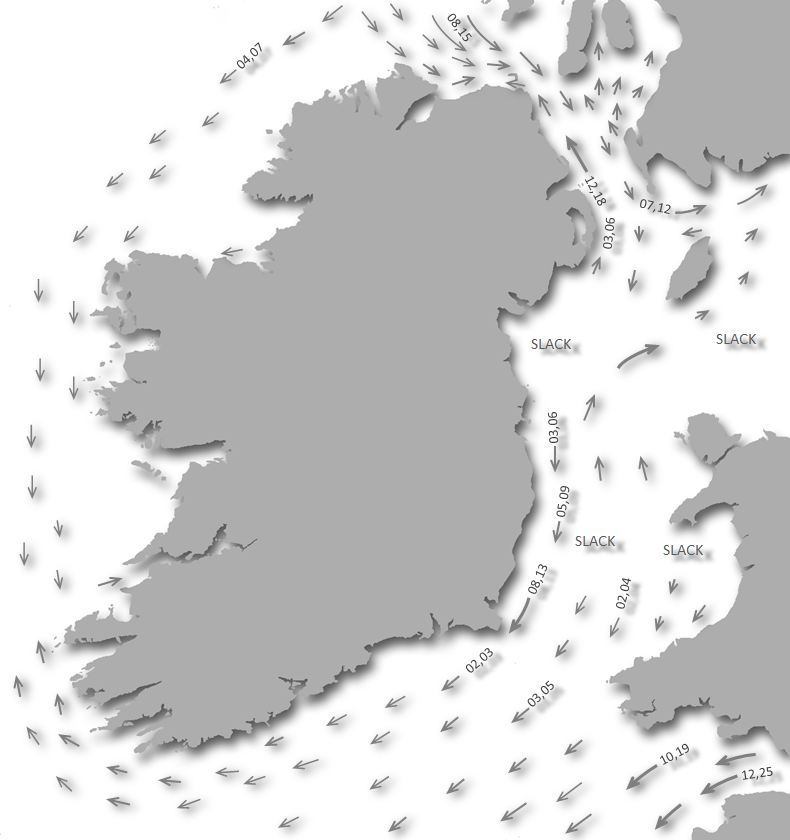


What are the key points of the approach?
Strangford Lough to Dublin Bay
 with details for vessels approaching from the south available in the Dublin Bay to Rosslare Harbour coastal overview. Use Howth Harbour's
  directions for local approaches.
Not what you need?
- Howth - 0.5 nautical miles NNW
- Carrigeen Bay - 1.1 nautical miles NNW
- Malahide - 5.2 nautical miles NW
- Dún Laoghaire Harbour - 6 nautical miles SSW
- Talbot’s Bay - 6 nautical miles N
- Dublin Port - 6.2 nautical miles WSW
- Seal Hole Bay - 6.4 nautical miles NNE
- The Boat Harbour - 6.5 nautical miles N
- Saltpan Bay - 6.7 nautical miles NNE
- Dalkey Island - 7 nautical miles S
- Howth - 0.5 miles NNW
- Carrigeen Bay - 1.1 miles NNW
- Malahide - 5.2 miles NW
- Dún Laoghaire Harbour - 6 miles SSW
- Talbot’s Bay - 6 miles N
- Dublin Port - 6.2 miles WSW
- Seal Hole Bay - 6.4 miles NNE
- The Boat Harbour - 6.5 miles N
- Saltpan Bay - 6.7 miles NNE
- Dalkey Island - 7 miles S

Chart

What's the story here?
 Balscadden Bay tucked in under the Ben of Howth to the southeast of Howth
Image: Estaubé via CC BY-SA 2.0
Balscadden Bay is situated beneath the cliffs to the south of Howth Harbour and on the northern side of the Ben Of Howth peninsula that forms the northern arm of Dublin Bay. It is situated close outside the extensive fishing port and yachting centre of Howth Harbour.
It makes for a convenient anchorage as Howth Harbour is subject to overcrowding and it is of itself well protected from prevailing winds. It is subject to swell however so it is better thought of as a settled conditions anchorage.
How to get in?
 Balscadden Bay as seen from the southeast
Image: Michael Harpur
 Use the directions provided for Howth Harbour's for approaches to Balscadden Bay. The bay is readily located from all directions by following the line of Howth Harbour's East Pier and it's conspicuous overlooking Martello tower. This tower is situated on a prominent bluff to the immediate east of the bay and is known locally as 'Tower Hill'. Once identified the approach must be from seaward to avoid the bay's fringing rocks.
  From the initial fix come in slowly west by southwest towards the strand in the corner of the bay maintaining a careful watch for rocks, carefully sounding all the way in. Keep well out of the area situated between the tower and the harbour wall as fringing rocks that dry to 2 metres reach out more than 150 metres to seaward in this area.
These rocks must be identified during the approach and certainly before anchoring in the inner reaches of the bay. So good visibility is required and if this is not available it would be best to anchor further out than normal in at least 5 metres.
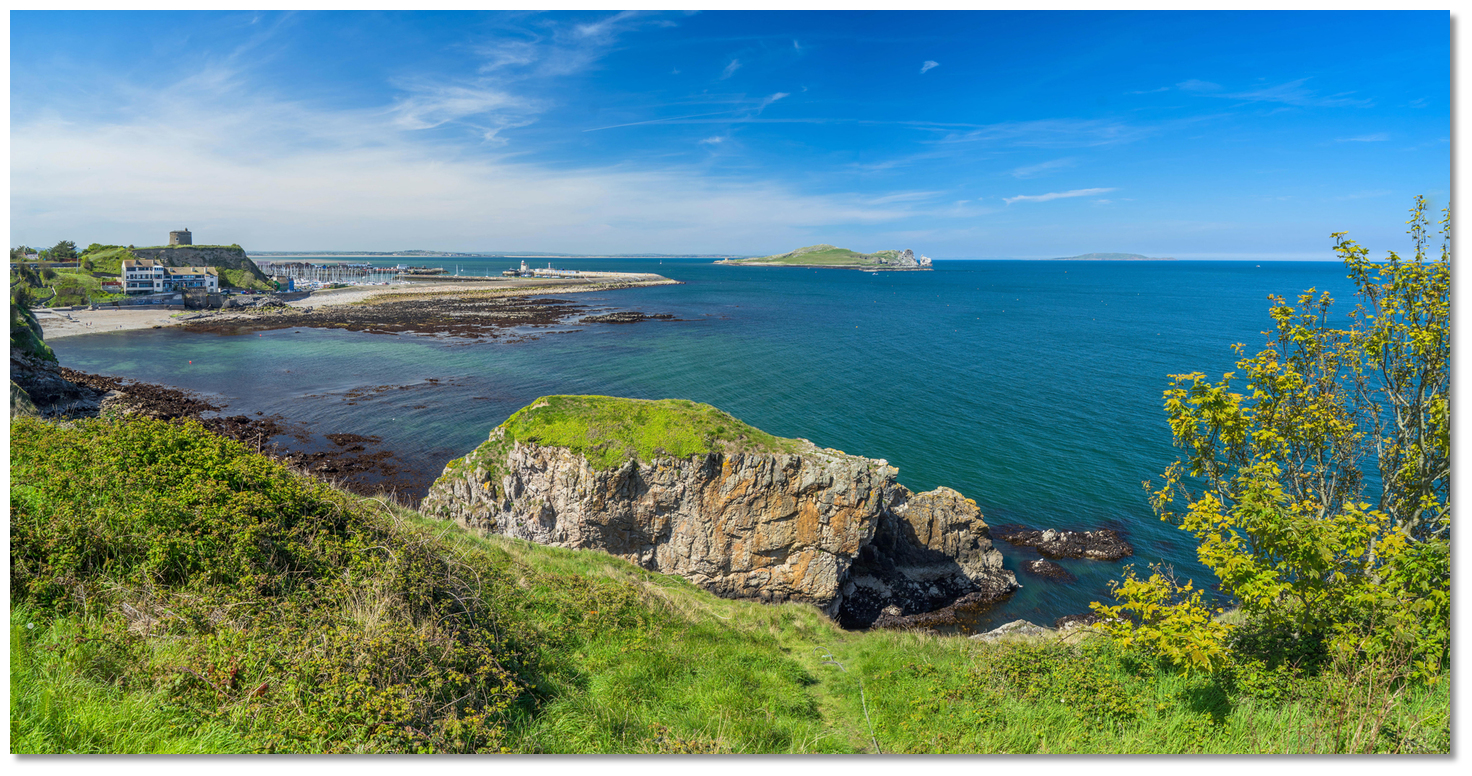 The bays skirting rocks eastward of the tower visible
Image: Michael Harpur
However, anchoring further out places a vessel in the area where disused cables have been discarded as seen on the chart. The official line on the cables is that they were cut off, pulled back from the swimming area on the foreshore and left in situ on the seabed. This happened many decades ago and a headland marker has ceased to be maintained for almost as long. They could present a hazard to anchoring craft as their whereabouts is now uncharted, marked or monitored. As a minimum, it is advised that a solid tripping line be deployed when anchoring in this area. This will also help with the lobster pots in the season, not all of which are marked by a buoy, which lie in this area.
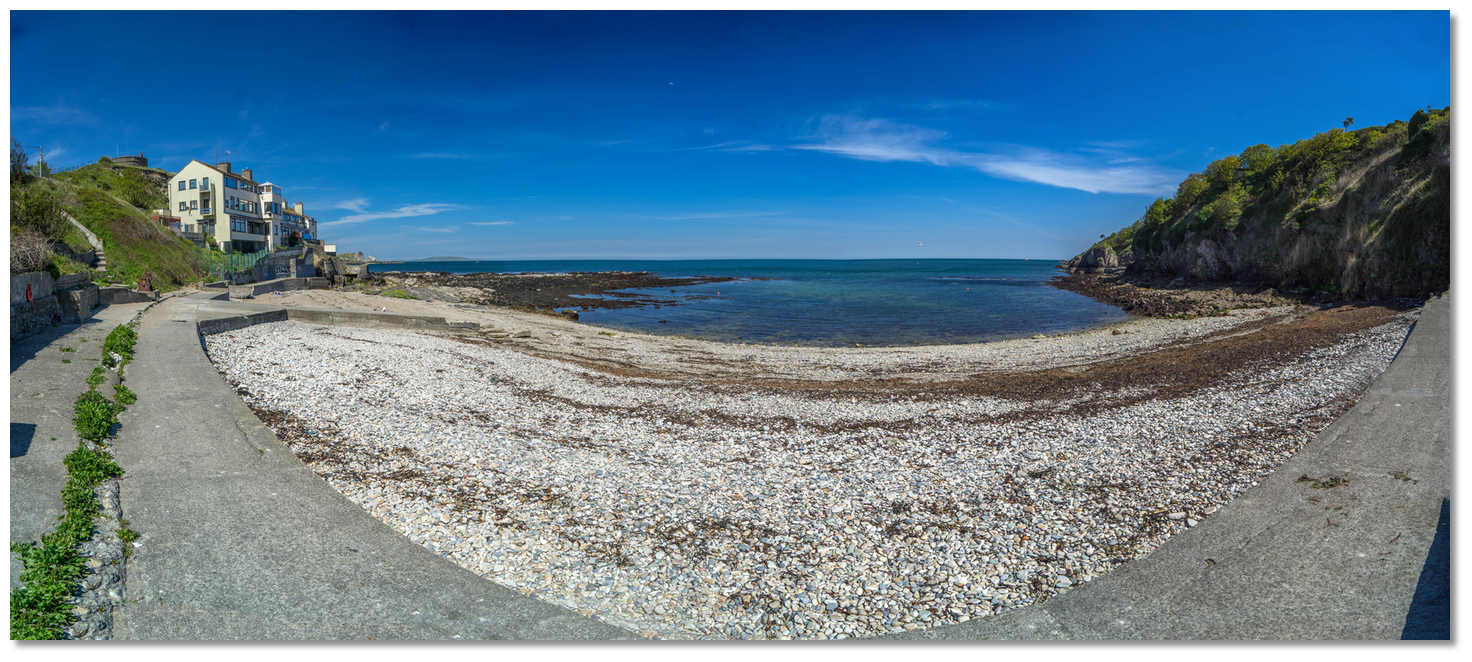 Balscadden Beach
Image: Michael Harpur
Anchor according to draft and conditions. The 2 metre contour line is very close to some rocks so keep the scope short inshore. Likewise, be careful to check the holding is secure after anchoring as seaweed is prevalent in this area.Why visit here?
Balscadden is derived from the Irish name Baile na Scadán that means the town or homeland of the herrings. The name indicates that it may have served as a fish market for landing boats in past times. Balscadden Beach when it was a bathing resort circa 1905
Image: National Library of Ireland on The Commons
Its next known use was in the period just after World War One when it was a favourite bathing-place, for genteel society. Then the small cove was designated as the ladies beach. In accordance with the proprieties of the day, the men’s facilities were to be found further around the bay, away from the ladies. The Dalriada Tea Shop served the ladies with refreshments immediately above the beach. One of its bathers must have been a young William Butler Yeats.
 William Butler Yeats by John Singer Sargent 1908
Image: Public Domain
Yates went on to be Ireland’s leading poet and, having been awarded the Nobel Prize in Literature, became one of the foremost figures of 20th-century literature. It is said that the happiness they found combined with the house's beautiful aspect could have had a major influence on the poet's early works. A plaque commemorating the families stay has some of Yate’s immortal lines on it. W. B. Yeats poet lived here 1880 -1883 "I have spread my dreams under your feet. Tread softly because you tread on my dreams".
 Plaque on Balscadden House where the Yeats family lived today
Image: Michael Harpur
Today Balscadden Bay is a lovely family beach. As with Howth Harbour, the bay serves as a good location to take a coastal walk along the Howth peninsula. A particularly good public path and steps lead from the bay up and around the Nose of Howth and onto the clifftops.
 Balscadden's gravel beach today
Image: Michael Harpur
From a boating perspective, if it is not possible to secure a berth in Howth Marina or outside the harbour, this is an excellent alternative location in which to anchor given favourable conditions. The Bay is also a tranquil escape from the busy harbour which it fringes.
What facilities are available?
There are no facilities in Balscadden Bay save for a landing beach with steps and pathway up to the road above.Any security concerns?
A vessel is most likely to be alone in Balscadden Bay, but it is uncertain how secure a dingy would be if left on the beach. Those with a fast outboard could land in the marina if it needs to be left unattended for some time.With thanks to:
Charlie Kavanagh, ISA/RYA Yachtmaster Instructor/Examiner and Burke Corbett. Photography by Kinsie84, Jojo Nemcok, William Murphy, Daniel Dudek-Corrigan and Ana Rey.
.jpg)
.jpg)
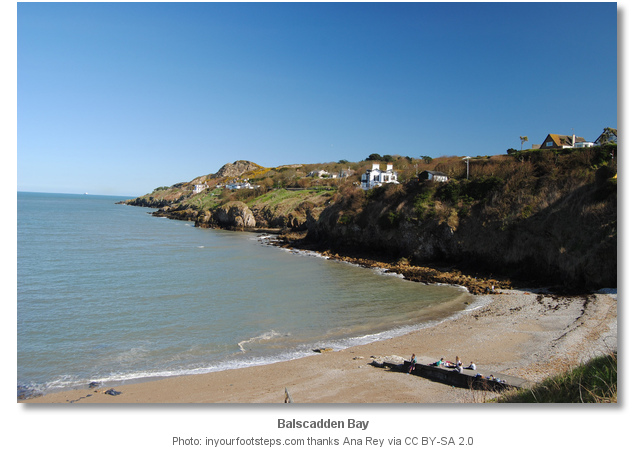
A family enjoying the beach area
A view of the bay from where Ireland's most famous poet W.B. Yeats stayed.
A taste of Yates poetry 'When You Are Old' read by Colin Farrell


 A photograph is worth a thousand words. We are always looking for bright sunny photographs that show this haven and its identifiable features at its best. If you have some images that we could use please upload them here. All we need to know is how you would like to be credited for your work and a brief description of the image if it is not readily apparent. If you would like us to add a hyperlink from the image that goes back to your site please include the desired link and we will be delighted to that for you.
Add your review or comment:
Rodolphe Thimonier wrote this review on Jun 22nd 2016:
Good shelter from westerly and southerly winds Constant small swell in the bay Many rocks: => an entrance at low water (and by daylight) is advisable => the 2m contour line is very close to some rocks and certainly requires a short chain length => the 5m contour line has a good holding Minefield of lobster pots (at least in June) where not all pots are marked by a buoy
Average Rating: UnratedMichael Harpur wrote this review on Aug 28th 2020:
Thank you Rodolphe, I have incorporated your very helpful observations into the main body of the text.
Average Rating: UnratedPlease log in to leave a review of this haven.
Please note eOceanic makes no guarantee of the validity of this information, we have not visited this haven and do not have first-hand experience to qualify the data. Although the contributors are vetted by peer review as practised authorities, they are in no way, whatsoever, responsible for the accuracy of their contributions. It is essential that you thoroughly check the accuracy and suitability for your vessel of any waypoints offered in any context plus the precision of your GPS. Any data provided on this page is entirely used at your own risk and you must read our legal page if you view data on this site. Free to use sea charts courtesy of Navionics.