

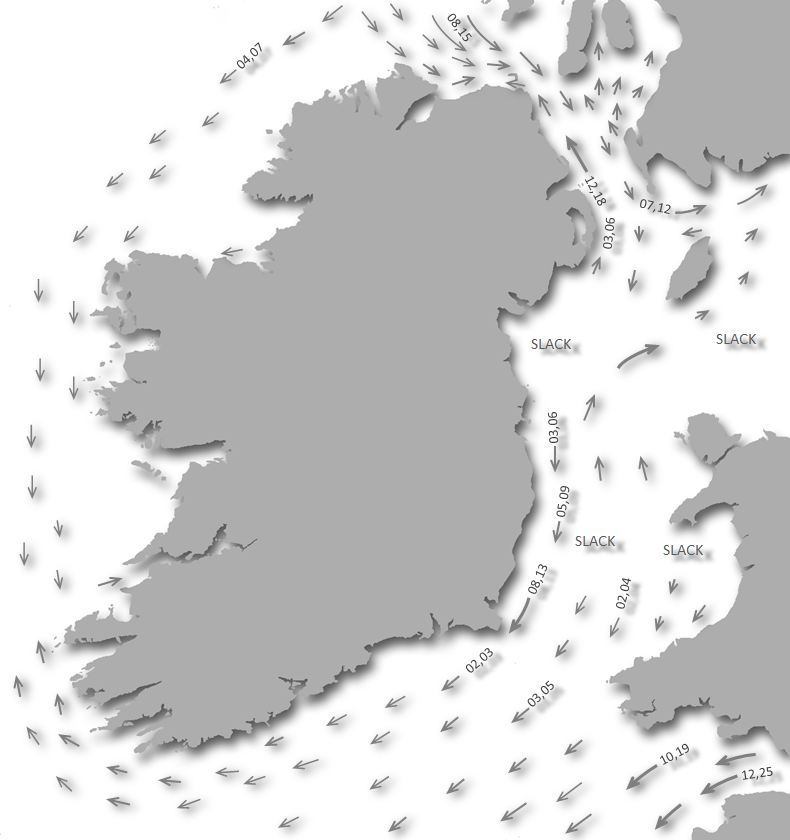
Greer’s Quay is a good anchorage. However, like most locations in Carlingford Lough, it is exposed to south-easterly conditions. With a large open expanse up to Warrenpoint, Greer’s Quay is also open to the northwest and in either of these conditions, the adjacent Carlingford Marina or the Port of Warrenpoint may be a better option. The entire inlet is also subject to heavy squalls descending from the hills in northwest winds. The pier may be accessed via Warrenpoint Port’s illuminated deep water shipping channel which runs the entire length of the lough. Though there is little to concern in the area surrounding the pier, careful navigation is generally required for this location owing to exceptional currents in the lower lough and at the entrance.

Keyfacts for Greer’s Quay
Facilities


Nature


Considerations


Protected sectors

Approaches

Shelter

Last modified
September 9th 2022 Summary* Restrictions apply
A good location with careful navigation required for access.Facilities
Nature
Considerations
Position and approaches

Expand to new tab or fullscreen
Haven position
 54° 4.393' N, 006° 14.031' W
The pierhead at Greer’s Quay.
What is the initial fix?
The following Carlingford Lough Entrance Initial Fix will set up a final approach:
 54° 0.100' N, 006° 2.052' W



What are the key points of the approach?
Offshore details are available in eastern Ireland’s Coastal Overview for Strangford Lough to Dublin Bay  and directions for the run up the lough are available in the Warrenpoint
  entry.
and directions for the run up the lough are available in the Warrenpoint entry.- From the entrance follow the well-buoyed and lit commercial channel up the length of the inlet.
- When Warrenpoint's entrance channel marker is drawing near break off for the pier and anchor out to the northeast of the pierhead.
Not what you need?
Click the 'Next' and 'Previous' buttons to progress through neighbouring havens in a coastal 'clockwise' or 'anti-clockwise' sequence. Below are the ten nearest havens to Greer’s Quay for your convenience.
Ten nearest havens by straight line charted distance and bearing:
- Omeath - 1.2 nautical miles NNW
- Rostrevor - 1.5 nautical miles ENE
- Warrenpoint - 1.5 nautical miles NNW
- Killowen - 1.6 nautical miles E
- Carlingford Marina - 2 nautical miles SE
- Carlingford Harbour - 2.6 nautical miles SE
- Greencastle - 5.1 nautical miles ESE
- Giles Quay - 5.3 nautical miles S
- Dundalk - 6.7 nautical miles SW
- Newry - 6.8 nautical miles NNW
These havens are ordered by straight line charted distance and bearing, and can be reordered by compass direction or coastal sequence:
- Omeath - 1.2 miles NNW
- Rostrevor - 1.5 miles ENE
- Warrenpoint - 1.5 miles NNW
- Killowen - 1.6 miles E
- Carlingford Marina - 2 miles SE
- Carlingford Harbour - 2.6 miles SE
- Greencastle - 5.1 miles ESE
- Giles Quay - 5.3 miles S
- Dundalk - 6.7 miles SW
- Newry - 6.8 miles NNW

Chart

What's the story here?
 Greer's Quay on the southern shore of Carlingford Lough
 Image: Michael Harpur
Greer’s Quay is an isolated pier located near the head of the Carlingford Lough inlet on the southwestern shore. The pier dries out completely at low water but depths are good on approach and water can always be found for landing at the head of the pier.
How to get in?
 Greer's Quay with Warrenpoint in the backdrop
Image: Michael Harpur
 Use the directions provided for Warrenpoint for approaches and the run up the lough. When the No. 25 Starboard Light buoy, marking the dredged channel to Warrenpoint, is drawing near it is possible to turn off to port and cut directly to the anchoring area off the pier.
  Greer's Quay
Image: Michael Harpur
Anchor according to draft off the pierhead in mud. Expect 2 metres LWS to be available about 200 metres northeast of the pierhead.  The quay dries but there is always water available for a landing at the its head
Image: Michael Harpur
The pier dries out but 1.5 metres is always available at the very end of the pierhead. Therefore it is possible to comfortably land here at all stages of the tide. The inner area of the pier dries but has 4 metres at high water making it useful for vessels that can take to the hard.
Why visit here?
Greer's Quay is named after the local landowner Robert Walker Greer. Greer was the local landlord who commissioned the construction of the quay in the 1840s to help develop Carlingford Lough’s fishing industry. Greers Quay was built in the 1840s
Image: Michael Harpur
Soon after 'A picturesque handbook to Carlingford Bay and the watering places within its vicinity'- circa 1840, noted "A little farther on, below the Ryland Water, is a small pier, erected within the last five years, at the joint expense of the Government and of the Marquis of Anglesey. It is in a little cove and affords shelter to the fishing smacks, which seek its friendly protection from the wintry storms".
 The DNGR passed along the shoreline above - now the Greenway
Image: Michael Harpur
But things did not entirely go to plan for Robert Walker Greer. He had built the elegant mansion of Ballyoonan House upon 14 acres of the shores of Carlingford Lough and he planned to spend his retirement here. But in 1873 the Dundalk, Newry, Greenore Railway, (DNGR) built a railway to provide a link between the towns in its title. These connected along the coast to the North Western Railway port at Greenore from where a ferry service operated to Holyhead. 'White's Crossing', which then became 'White's Halt', allowed railway access to the pier. But the service puffed and steamed it's way right past Greer’s beautiful home. It so destroyed his peaceful abode that Greer depart for a town residence in Leeson Park, Dublin where he passed away unexpectedly in 1876.
 The pier anchorage is short distance from Warrenpoint
Image: Michael Harpur
Ballyoonan House was later bought by the Rosminians and became St. Michael’s College. Now it is the Tain Holiday village water sports location. The railway thrived for half a century but from 1923 onwards it fell into progressive decline. As steam trains are expensive to run, the Great Northern Railway introduced cheaper 'railbuses' when it took over running the line in 1933. But it could not arrest the decline and the decision was made to finally close the railway in 1951. The route of the former DNGR railway is today the Carlingford Lough Greenway. Little has changed for stone-built Greer's Quay since it was built and remains in good condition supporting a fishing vessel and several small angling boats.
 The pier still serves the fishermen of the Lough to this day
Image: Michael Harpur
From a boating perspective, Greer's Quay offers another anchoring location from which to enjoy the Cooley Peninsula and the Lough itself. Nestled in the picturesque sequestered setting Greer’s Quay provides another good anchorage and all tide tender landings at the head of the quay. It is an ideal location to strike off for a walk along the Greenway or out through the open countryside. The small village of Omeath is a two-mile stroll.
What facilities are available?
There are no facilities at Greer’s Quay except for a high water launching slip, and there are reportedly local moorings in the area. At Omeath, a distance of approximately two miles, there is a very small village that has a restaurant, pub, basic provisions, gas, and a petrol station.Any security concerns?
Never an issue known to have occurred at Greer’s Quay.With thanks to:
Brian McJury, Warrenpoint Harbour Master.Aerial views od the northwest end of the Lough
Northern Ireland tourist board overview of Carlingford Lough


 A photograph is worth a thousand words. We are always looking for bright sunny photographs that show this haven and its identifiable features at its best. If you have some images that we could use please upload them here. All we need to know is how you would like to be credited for your work and a brief description of the image if it is not readily apparent. If you would like us to add a hyperlink from the image that goes back to your site please include the desired link and we will be delighted to that for you.
Add your review or comment:
Please log in to leave a review of this haven.
Please note eOceanic makes no guarantee of the validity of this information, we have not visited this haven and do not have first-hand experience to qualify the data. Although the contributors are vetted by peer review as practised authorities, they are in no way, whatsoever, responsible for the accuracy of their contributions. It is essential that you thoroughly check the accuracy and suitability for your vessel of any waypoints offered in any context plus the precision of your GPS. Any data provided on this page is entirely used at your own risk and you must read our legal page if you view data on this site. Free to use sea charts courtesy of Navionics.